Institutional Insights: JPM FX FOMC Post-Mortem

JPM FX FOMC Post-Mortem — USD Hit by Fed Credibility Risk, but Long-Dollar Trade Not Dead
JPM’s FX strategy team argues that Wednesday was a material setback for the dollar, but not enough to abandon the long-USD trade. The FOMC initially had hawkish components — including three dissents and hawkish prepared remarks — but the press conference reintroduced concerns about the Fed’s credibility in lowering inflation. That drove an aggressive 2s30s twist steepening, a rise in inflation risk premium, and a sharp USD selloff.
The key message:
The dollar sold off not because the Fed was dovish in the conventional sense, but because markets began embedding Fed credibility and inflation-risk premium into FX.
Despite that, JPM stays long USD versus a basket of G10 low-yielders: EUR, CHF, SEK, CAD, and NZD.
1. What Happened: Hawkish Start, Credibility-Damaging Press Conference
Going into the FOMC, JPM saw upside risks for USD. The rationale was straightforward:
Hawkish Fed speak had been building.
Markets expected material dissents.
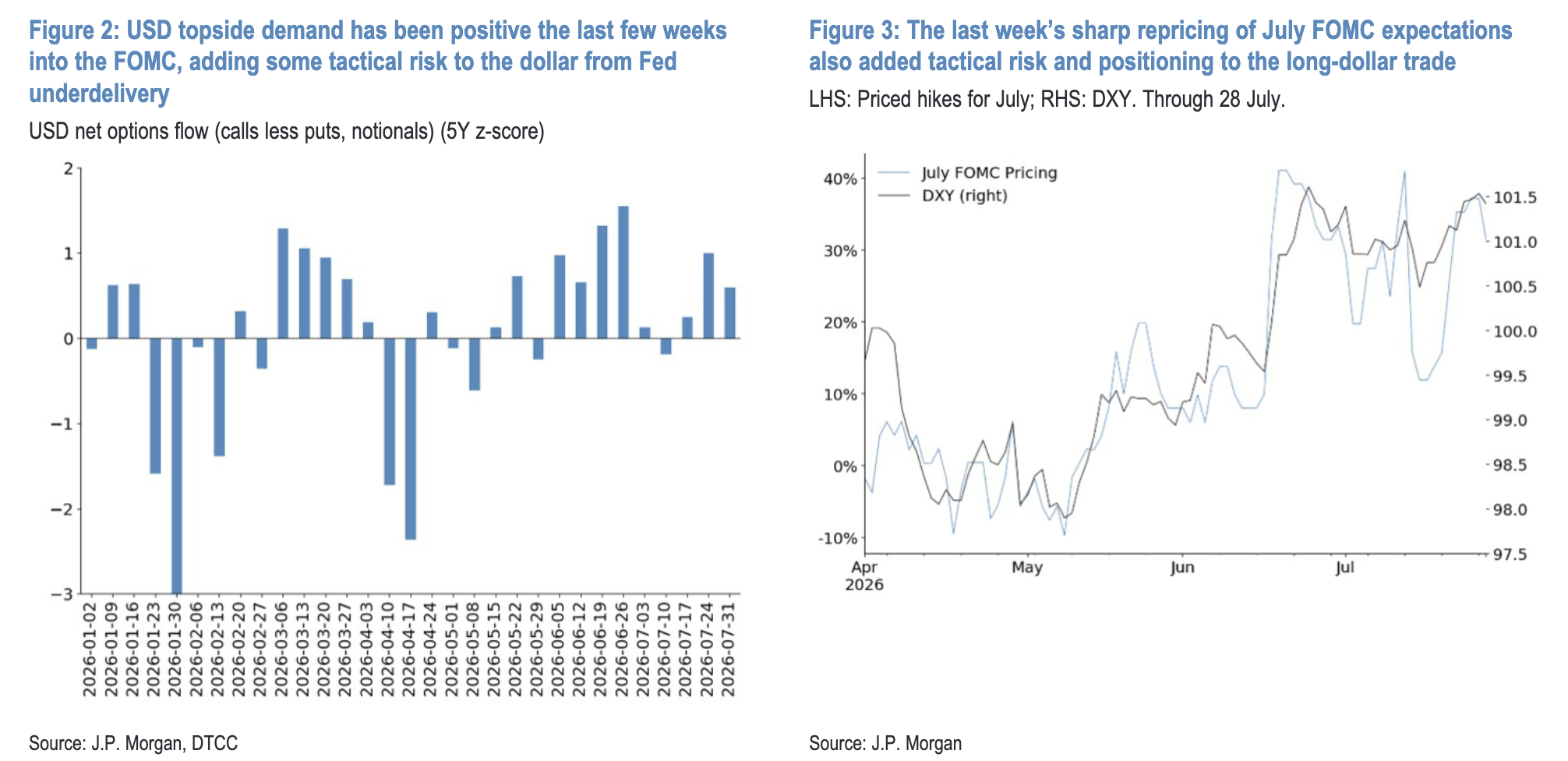
USD topside demand had been positive in recent weeks.
July hike pricing had risen sharply.
The 2pm release initially looked dollar-supportive:
Three hawkish dissents.
Hawkish prepared remarks.
The Fed did not deliver a dovish pivot.
But the press conference shifted the market narrative. According to JPM economists, Chair Warsh raised credibility concerns by:
Casting doubt on the future of PCE as the Fed’s inflation target.
Failing to articulate a clear path to achieving inflation targets.
Providing limited color on the nature of the dissents.
Emphasizing that markets had repriced during the inter-meeting period.
That combination reduced confidence in the Fed’s inflation-fighting credibility and triggered a selloff in USD.
2. The Dollar Sold Off on a Twist Steepener
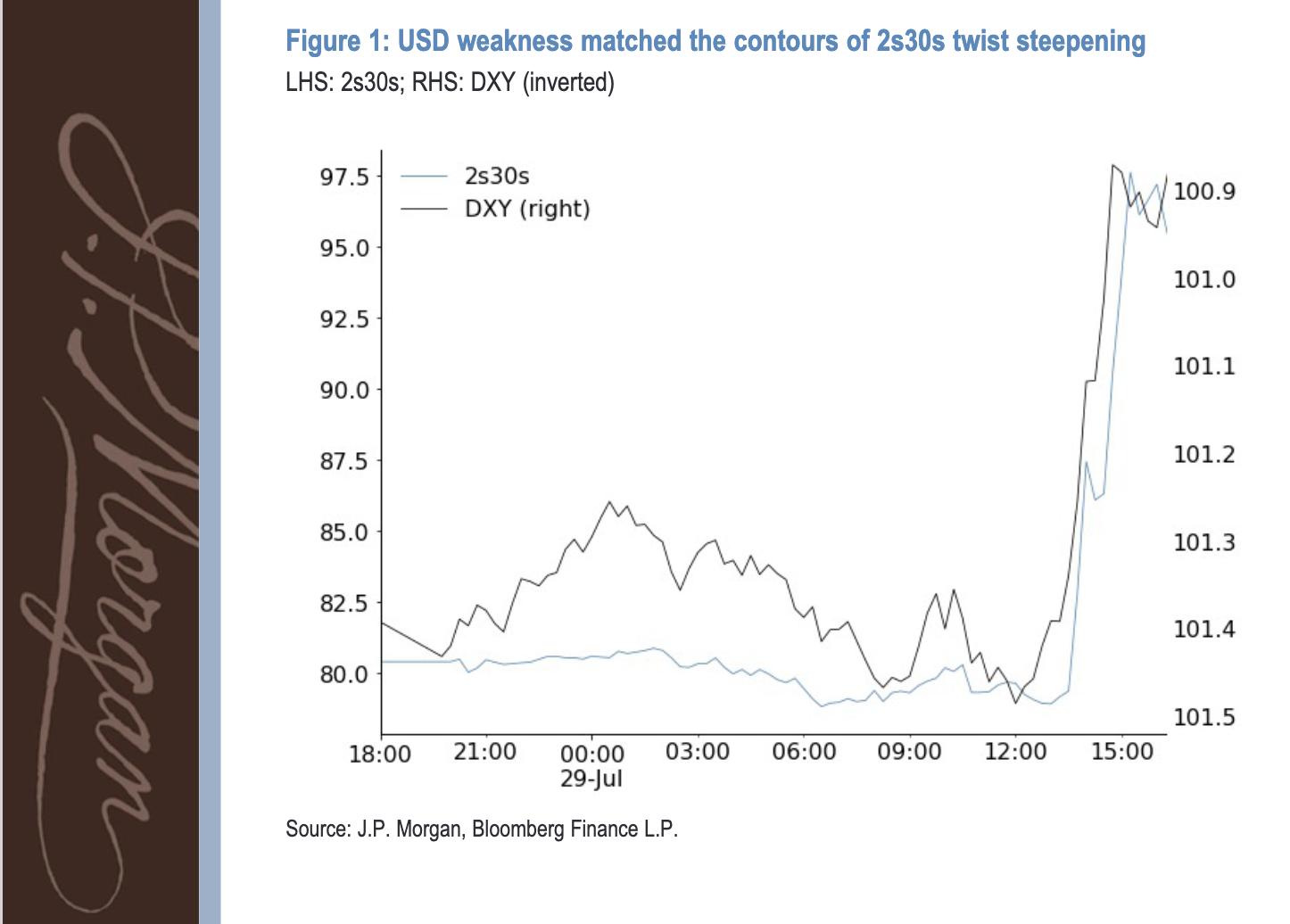
The most important market signal was the curve reaction. JPM rates strategists noted a +15bp end-to-end 2s30s twist steepening, the largest single-day FOMC-day curve move over the last ten years.
The curve move was:
Short-end yields lower
Long-end yields higher
Breakevens up 4–7bps
Long-end yields reaching post-2007 highs
This is a particularly negative mix for the dollar. It implies the market is pricing:
Less confidence in near-term policy tightening
More inflation risk premium in the long end
Higher term premium
Weaker Fed credibility
The USD weakness matched the contour of the 2s30s steepening almost exactly during the press conference.
The transmission channel:
Fed Credibility Concern→Inflation Risk Premium→2s30s Twist Steepening→USD SelloffFed Credibility Concern→Inflation Risk Premium→2s30s Twist Steepening→USD Selloff
This is different from a normal “rates down = USD down” move. It is a more corrosive type of dollar weakness because it reflects institutional credibility risk.
3. Why Twist Steepening Is Bad for USD
JPM highlights that USD rarely performs well when short-end rates fall and long-end rates rise.
That configuration hurts the dollar because:
The front-end carry advantage erodes.
Long-end inflation / fiscal / term-premium risk rises.
Real yields may fall even as nominal long-end yields rise.
Investors question the quality of the policy anchor.
USD assets become less attractive on a risk-adjusted basis.
This combination is especially negative when inflation breakevens rise while real yields fall. It resembles prior episodes where Fed independence or credibility was questioned, such as July 2025 when rumors around Chair Powell’s dismissal weighed on the dollar.
The key phrase:
Inflation breakevens rising while real yields fall is corrosive for the dollar.
4. Gold Becomes a Barometer of the Debasement Trade
JPM notes that gold can act as a barometer for whether the Fed credibility issue is morphing into a broader USD debasement trade.
This aligns with the broader gold framework. If long-end term premium rises because investors question Fed credibility, and if breakevens rise while real yields fail to rise, gold can benefit from:
Debasement concerns
USD diversification
Inflation risk premium
Central-bank reserve reallocation
Lower confidence in fiat-policy anchors
So gold’s behavior matters. A sustained gold bid alongside a weaker USD and steeper curve would signal the market is treating the FOMC as more than a one-day communication error.
5. G10 FX Implications
JPM’s cross-G10 interpretation is nuanced.
SEK
A more dovish Fed reaction function, especially if Warsh appears dismissive of inflation, would favor rate-sensitive currencies with faster pass-through and solid fiscal policy, such as SEK. However, JPM says this is not their go-with view, and they remain short SEK.
GBP and JPY
GBP and JPY could underperform if US term-premium concerns spill over into global long-end bond weakness.
Both currencies are sensitive to long-end fiscal risk premium:
GBP through UK fiscal credibility / gilt risk
JPY through long-end JGB / fiscal sustainability dynamics
So if US curve steepening contaminates global bond markets, GBP and JPY may not behave as clean safe havens.
EUR
Fed credibility risk may slow EUR’s convergence lower toward fair value, but JPM does not think it alters the direction of travel weaker for EUR. They still prefer USD versus EUR as part of the low-yielder basket.
6. Why JPM Stays Long USD
Despite the setback, JPM argues the long-dollar trade still has several supports.
1. Fed Call Moved Hawkishly
JPM has moved forward its Fed call and now expects a December hike. The reason is that the FOMC may feel compelled to act to maintain credibility. If the Fed hikes later to restore confidence, that should mitigate USD risk premium.
2. September Is Still Live
Although September hike risk fell after the meeting, it remains live and data-dependent. If inflation heats up again, September can return quickly as a USD-positive catalyst.
3. Short-End Rate Differential Erosion Was Limited
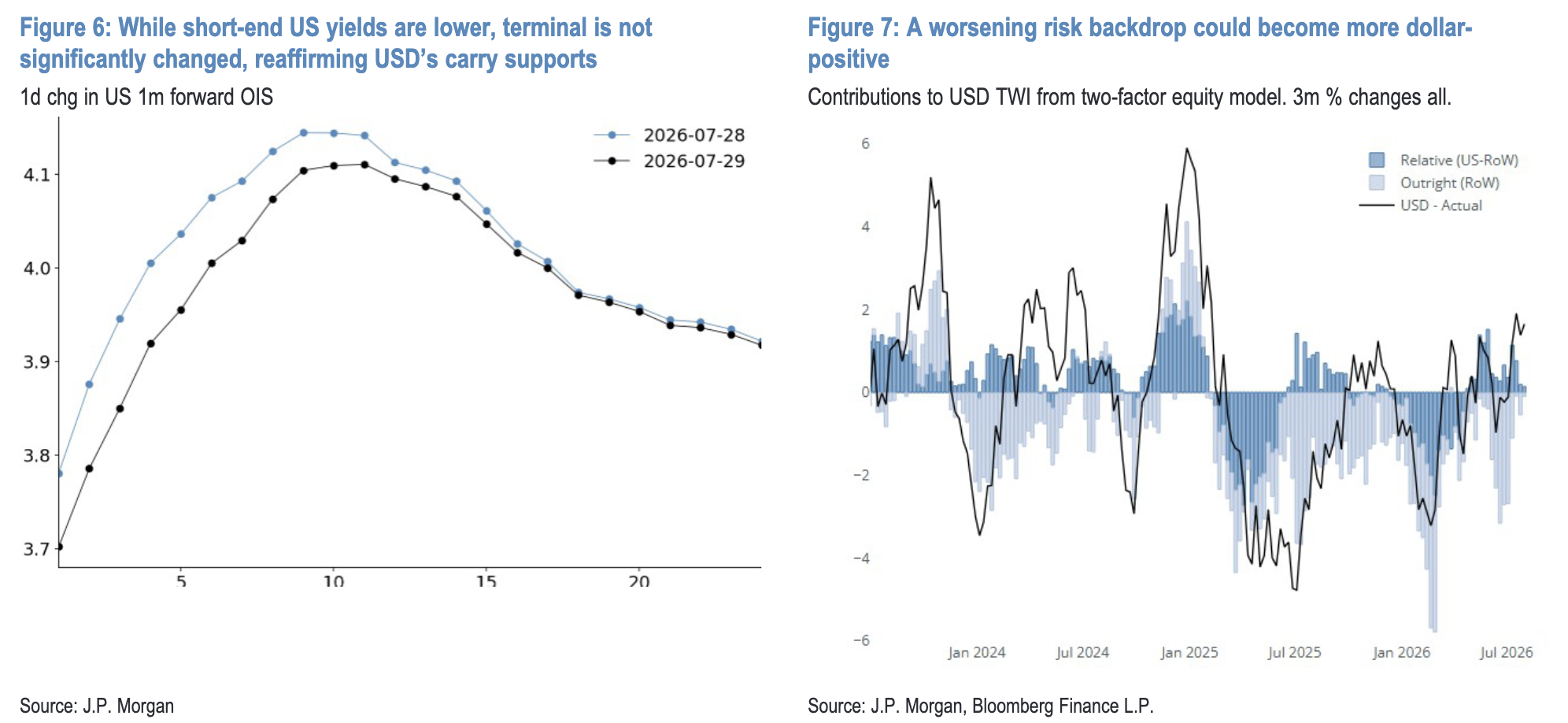
US 1-month forward OIS under one year fell only around 5–6bps through the FOMC. The market still prices terminal rates roughly 50bps above current rates.
That matters because USD carry support has not been destroyed. As long as the long end settles, the dollar retains insulation from more aggressive selling.
4. US Data Remain Solid
Initial claims and broader labor-market indicators remain constructive for USD. Solid data can revive rate support, especially if payrolls are firm.
5. Iran / Energy Provides Terms-of-Trade Support
Renewed Iran escalation supports USD through:
Energy-price effects
Geopolitical risk-off
Terms-of-trade dynamics
Safe-haven demand if the conflict worsens
6. Global Equity Weakness Can Support USD
A US-led AI equity selloff has mixed implications for USD. But a broader global equity selloff would engage USD’s anti-cyclical properties. JPM notes that over the past decade, a roughly 5.5% global equity selloff has been consistent with around +1% in the USD trade-weighted index.
7. Preferred Trade: Long USD vs Low-Yielder Basket
JPM remains long USD versus a basket of G10 low-yielders:
EUR
CHF
SEK
CAD
NZD
The rationale is that the USD still has:
Carry support
Solid data
Potential for later Fed hikes
Energy / geopolitical support
Anti-cyclical safe-haven properties
A supportive yield backdrop versus low-yielders
The trade is not without risk. If Fed credibility deteriorates further, inflation breakevens rise, real yields fall, and gold rallies sharply, USD downside could extend. But JPM does not view that as the base case.
8. Key Market Signals to Watch
Signal | USD Implication |
|---|---|
2s30s keeps steepening | Negative USD if driven by credibility / inflation risk |
Breakevens rise while real yields fall | Corrosive for USD |
Gold breaks higher | Signals debasement / Fed credibility trade |
Payrolls firm | Supports USD; revives Fed hike pricing |
Soft payrolls | Weighs on USD; reinforces front-end repricing lower |
Iran / oil escalates | Supports USD via risk-off / ToT |
Global equities sell off | Supports USD as anti-cyclical currency |
Long end stabilizes | Allows USD carry support to reassert |
9. Trading Interpretation
The dollar’s reaction is important because it was not the typical outcome expected from a hawkish hold. A hawkish hold with three dissents should ordinarily be USD-positive. Instead, the press conference created doubts about Fed credibility, leading to a weaker dollar and a twist steepener.
This means the dollar trade now depends on whether the market views Warsh’s press conference as:
A communication problem, or
A genuine regime shift in Fed credibility.
If it is only a communication problem, USD can stabilize and recover on data, carry, and later hike risk. If it is a regime shift, the dollar can weaken further despite high nominal yields, especially if gold and breakevens keep rising.
JPM’s view is that the first interpretation is more likely.
Disclaimer: The material provided is for information purposes only and should not be considered as investment advice. The views, information, or opinions expressed in the text belong solely to the author, and not to the author’s employer, organization, committee or other group or individual or company.
Past performance is not indicative of future results.
High Risk Warning: CFDs are complex instruments and come with a high risk of losing money rapidly due to leverage. 68% and 74% of retail investor accounts lose money when trading CFDs with Tickmill UK Ltd and Tickmill Europe Ltd respectively. You should consider whether you understand how CFDs work and whether you can afford to take the high risk of losing your money.
Futures and Options: Trading futures and options on margin carries a high degree of risk and may result in losses exceeding your initial investment. These products are not suitable for all investors. Ensure you fully understand the risks and take appropriate care to manage your risk.
Patrick has been involved in the financial markets for well over a decade as a self-educated professional trader and money manager. Flitting between the roles of market commentator, analyst and mentor, Patrick has improved the technical skills and psychological stance of literally hundreds of traders – coaching them to become savvy market operators!